Breast surgery

Breast cancer in women

Breast cancer is the leading cancer among women, and the second most common among all cancers, after prostate cancer for men.

Breast cancer is a tumor that develops from the cells that make up the mammary gland.

Malignant cells multiply uncontrollably, forming a tumor.

But beneath this general description lie several realities.

In fact, breast cancer is a heterogeneous disease: there are several types of tumor, which will be treated differently.

It all depends on the stage at which the cancer is detected.

- If the cancer cells are confined to the ducts or lobules of the breast, it's called carcinoma in situ.

- On the other hand, if the cancer cells have penetrated the so-called «basal membrane» of the ducts or lobules and invaded the surrounding tissue, it's an infiltrating carcinoma.

Cancer cells can spread either through the lymph nodes under the armpit, or via the veins.

There is a risk of developing metastases.

Breast cancer screening

Breast cancer is treatable if detected early. With this in mind, the health authorities are now suggesting that all women between the ages of 50 and 74 undergo breast screening every 2 years.

Although breast cancer can occur at any age, it most frequently affects women after the menopause.

This screening involves two tests.

  • Palpation of the breasts to detect any abnormalities
  • Mammography, a true X-ray of the breasts.

Diagnosis of breast cancer

To confirm and refine the diagnosis, doctors first use imaging tests, followed by a biological analysis of the tumour.

The first examination is often a mammogram.

This is an X-ray of the breasts. A tumor is either a mass or the presence of small white dots called «micro-calcifications», the number, shape and distribution of which may or may not indicate the presence of cancer.

Mammography is sometimes supplemented by two other imaging tests.

  • Ultrasound, on the other hand, uses ultrasound technology. It can tell, for example, whether the lump detected by ultrasound is a liquid cyst or a solid tumor.
  • More rarely, in special cases, the doctor may request an MRI (magnetic resonance imaging) scan.

After imaging, the diagnosis is confirmed by anatomopathological examination of a fragment of breast tissue.

Only a microscopic examination of a sample can confirm with certainty the diagnosis of breast cancer.

The doctor has several options.

  • Manual or ultrasound-guided microbiopsies
  • Stereotactic macrobiosis: X-rays are used for identification

These samples are then studied under the microscope, to determine whether the lesion is benign or cancerous.

In the second case, we need to go a step further and characterize the tumour: stage, type of cancer, etc.

After analysis, if the results suggest that the cancer may have spread to other parts of the body, further tests may be ordered, including chest X-rays, CT scans, MRIs and bone scans.

Breast cancer treatment

Different types of treatment can be used to treat breast cancer: surgery, radiotherapy, hormone therapy, chemotherapy and targeted therapies.

Breast cancer surgery is one of the steps in the treatment of cancer, and will only take place following a multidisciplinary therapeutic decision.

Breast cancer surgery

Breast surgery is the standard treatment for breast cancer.

It remains the most effective way of curing early-stage breast cancer.

It is almost always used at some stage of treatment, unless contraindicated.

However, it is rarely sufficient on its own, and often needs to be complemented by other treatments.

These depend on the cancer's stage of development, the tumor's characteristics and the type of surgery chosen.

Breast cancer surgery has three objectives:

  • Tumor removal
  • Confirm the diagnosis and determine the stage of the cancer, in particular by removing and examining certain lymph nodes
  • Maintain or restore breast size and shape after removal of tumor or entire breast.

the different types of surgery

There are two types of breast cancer surgery:

Conservative surgery, known as lumpectomy

And the removal of the breast, called a mastectomy.

Depending on the situation, a procedure on the axillary lymph nodes completes the operation.

Lumpectomy or conservative surgery

Conservative surgery aims to remove the entire tumor without removing the entire breast.

The tumor is removed with a safety margin, i.e. a zone of healthy tissue around the malignant lesion, to ensure that no malignant cells remain in the breast.

This safety margin limits the risk of recidivism.

The nipple and areola are preserved, except when the tumor is located just below them.

Conservative surgery is very often combined with sentinel lymph node examination, followed by additional radiotherapy on the operated breast.

When analysis of the tumour and surrounding tissue shows that the safety margin is insufficient, the surgeon may propose a second operation.

It can also happen that after a lumpectomy, the final results reveal that the tumor has not been completely excised, which may lead the surgeon to propose a mastectomy.

Conversely, when the tumor is too large to allow lumpectomy, the physician may propose chemotherapy before any other treatment to reduce the size of the tumor and allow conservative surgery to be considered at a later stage.

This is known as neoadjuvant chemotherapy.

Similarly, if the woman is menopausal, hormone therapy is sometimes recommended before surgery.

Mastectomy or removal of the breast

Total mastectomy involves removing the entire breast, including the areola and nipple.

Depending on the medical situation, breast reconstruction is offered, either simultaneously (immediate reconstruction) or as a second stage.

If breast reconstruction is deferred, the patient can wear an external breast prosthesis in the meantime.

Axillary lymph node surgery

Once breast cancer has been diagnosed, it is often essential to check whether or not the axillary lymph nodes contain cancer cells, and thus to measure the extent of the disease.

The axillary lymph nodes are then analyzed using the sentinel node technique.

The result is used to determine the choice of treatments.

In particular, it is used to determine whether lymph node removal, known as axillary lymph node curage, is necessary to prevent the development of the disease.

The sentinel node technique

The sentinel lymph node is the first lymph node to receive lymphatic drainage from a tumor.

It is representative of the other lymph nodes in the armpit, and can therefore be used to determine whether or not axillary curage is necessary.

A lymph node is said to be «positive» when it is affected by cancer cells, and «negative» when it is not.

The advantage of the sentinel lymph node technique is that it avoids the inconvenient consequences of systematic axillary lymph node dissection, which proves unnecessary when the lymph nodes sampled are negative.

So that the sentinel lymph node can be easily located by the surgeon during the operation, the Nuclear Medicine Service physician injects a radioactive product (called a tracer) in the vicinity of the tumour or near the areola of the breast a few hours before the operation.

This product passes through the lymphatic system to concentrate in the first axillary lymph nodes.

A scintigraphy performed at this time helps to pinpoint their location, thus facilitating their removal by the surgeon.

Axillary lymph node dissection

If cancer cells have been detected in the axillary lymph nodes, axillary lymph node dissection is performed.

This involves removing about ten lymph nodes located under the arm.

It is performed at the same time as conservative surgery or mastectomy.

If lymph node involvement is only detected after definitive analysis of the sentinel lymph node, axillary dissection may be carried out at a later stage.


 

Male breast cancer

Men also have breasts, but they are less developed than those of women.

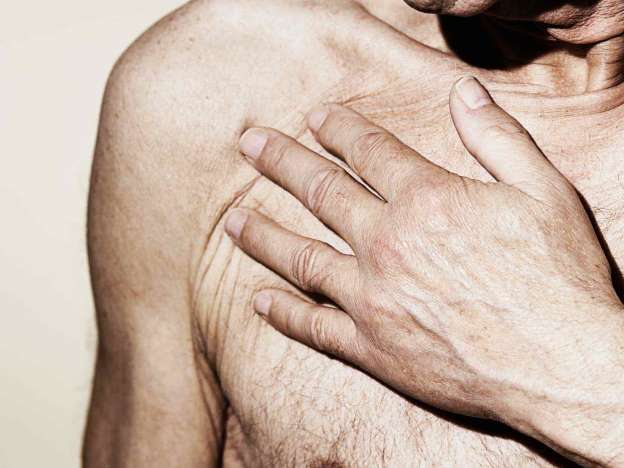
Male breast cancer is rare. Less than 1 % of all breast cancers occur in men.

However, it's important for men to be aware that they may be affected by this cancer, particularly so as not to neglect the symptoms.

RISK FACTORS

Certain factors can increase a man's chances of developing breast cancer.

  • Age: a man's risk of developing breast cancer increases with age. Breast cancer is more frequently diagnosed in men over 60.
  • A family history of breast cancer: men who have a close male or female relative with breast cancer are more likely to develop the disease. The risk increases with the number of close relatives affected.
  • Genetic predisposition: around 15% of male breast cancers are linked to an inherited mutation in the BRCA2 gene.
  • Klinefelter's syndrome: a very rare hereditary (genetic) disorder. In men with this syndrome, androgen levels are low and estrogen levels are high: both are linked to an increased risk of breast cancer.
  • Radiation exposure: previous exposure to radiation, particularly of the thorax, increases the risk of male breast cancer.
  • Cirrhosis of the liver: a liver damaged by cirrhosis raises estrogen levels and lowers androgen levels, both of which are linked to an increased risk of breast cancer.

OTHER POSSIBLE RISK FACTORS

  • Gynecomastia (exaggerated breast development in men).
  • Obesity.
  • Alcohol consumption.
  • Testicular problems: undescended testicle (cryptorchidism), removal of one or both testicles (orchiectomy), adult mumps.
  • Occupational exposure: steelworks, blast furnaces, rolling mills, petrol fumes and exhaust gases.

Most men with breast cancer have invasive ductal carcinoma.

Other types of breast cancer are very rare.

The symptoms, disease course and management of invasive ductal carcinoma (diagnosis, treatment, follow-up) are virtually identical in men and women.

Care philosophy

A holistic approach to women's health

Dr Nadia Oukacha puts her expertise in gynecology, obstetrics and fertility at the service of every woman, combining listening, prevention and cutting-edge technology.

Active listening and caring

Each consultation begins with an in-depth discussion to understand your needs and establish a climate of trust.

Comprehensive, personalized approach

A complete check-up, nutritional advice and psychological follow-up are adapted to your age and life situation.

Focus on prevention

Regular smear tests, screening and check-ups aim to anticipate risks and preserve your health over the long term.

Frequently asked questions (FAQ)

Here you'll find answers to the most frequently asked questions about consultations, specialties, booking appointments and how the practice works.

How do I make an appointment with Dr Oukacha?

You can book your consultation directly online via our website or by calling the practice on +212 606 12 12 13. A contact form is also available on the site.

What are Dr Nadia Oukacha's specialties?

Dr Oukacha specializes in :

  • Gynecology (consultations, pap smears, colposcopy, ultrasounds)

  • Obstetrics (pregnancy monitoring, ultrasound, amniocentesis)

  • Intimate and breast surgery

  • Fertility and medically assisted reproduction (MAP)

What examinations are carried out at the clinic?

The practice is equipped for :

  • Gynecological and obstetrical ultrasounds

  • Cervico-vaginal smear

  • Colposcopy

  • Fertility assessment

What are the opening hours?

  • Monday to Friday: 9:00 am - 5:00 pm

  • Saturday: 9:00 am - 1:00 pm

  • Sundays and public holidays: closed

Where is the office located?

The office is located in Casablanca, at 125 BD Brahim Roudani, 1st floor, Appt 11. An interactive map is available on the Contact page.

Book your consultation

Access specialized gynecology, obstetrics and fertility care with confidence and simplicity.