

Flap reconstruction uses your own tissues (skin, fat, muscle) to restore breast volume by moving them from another part of the body (back, abdomen).This technique is also called autologous reconstruction. It is contraindicated for smokers (who have poorer blood supply to their tissues). Different types of flaps are used depending on the …

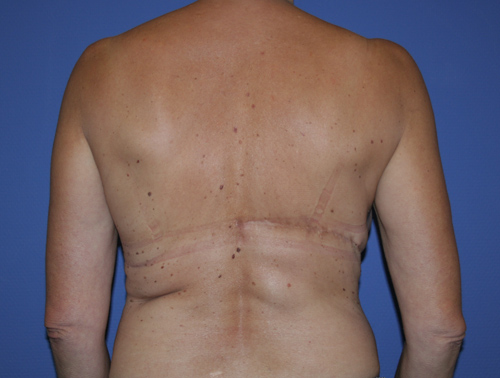
Flap reconstruction uses your own tissue (skin, fat, muscle) to restore breast volume by moving it from another part of the body (back, abdomen).
This technique is also known as autologous reconstruction.
It is contraindicated for women who smoke (who have poorer blood flow to their tissues).
Different types of flaps are used depending on the case: the latissimus dorsi muscle flap, the rectus abdominis muscle flap, or a flap of skin and fat harvested from the abdomen known as a DIEP (Deep Inferior Epigastric Perforator) flap.
The Pros and Cons
ITS BENEFITS
The results of this technique are often satisfactory from an aesthetic standpoint.
The shape and suppleness of the breast are more natural and less rigid than with a breast implant, since the breast is made up of the patient's own tissue.
ITS DRAWBACKS
The procedure is more complex and takes longer than breast implant surgery.
It usually takes 12 to 18 months to achieve a satisfactory outcome, both physically and psychologically.
Although it usually fades over time, a new scar forms at the site where the flap is harvested.
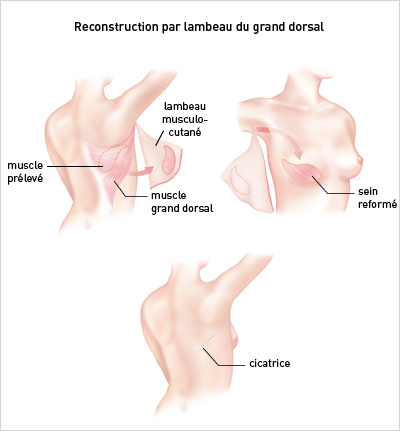
Flap Reconstruction of the Latissimus Dorsi Muscle
The latissimus dorsi is a thin, broad muscle in the back.
During a latissimus dorsi flap reconstruction, the surgeon removes almost the entire muscle and the amount of skin needed to reconstruct the removed breast.
This musculocutaneous flap remains connected to the armpit via the axillary artery, nerve, and vein, which keep it alive.
The surgeon inserts the flap through the armpit and slides it under the skin of the chest to the breast that is to be reconstructed.
The surgeon adjusts the amount of skin he removes to match the amount of skin that was removed from the chest during non-conservative breast surgery (or mastectomy).
If the procedure was performed while preserving the skin flap, the amount of skin taken from the back will be less than if it had required the removal of a larger area of skin (particularly if radiation therapy had been performed).
When the volume of transferred muscle is insufficient compared to the volume of the other breast, an implant is added to complete the reconstruction.
Reconstruction using a latissimus dorsi muscle flap results in a high-quality reconstruction.
Its main drawback is that it creates an additional scar on the back and results in reduced muscle strength on the side where the surgery was performed.
Furthermore, the color and texture of the skin on the back may differ from those of the skin in the breast area, resulting in differences in shade or appearance in the chest area once reconstruction is complete.
However, this technique is less restrictive and less time-consuming than reconstruction using a rectus abdominis muscle flap.
Rectus Abdominis Muscle Flap Reconstruction (TRAM)
This technique is often referred to as TRAM, which stands for Transverse Rectus Abdominis Myocutaneous Flap.
The rectus abdominis muscle extends from the pubis to the thorax.
During reconstruction using a rectus abdominis flap, the surgeon removes a large skin flap (from above the pubic bone to above the navel) to which a portion of the rectus abdominis muscle is attached, in order to reconstruct the breast removed during non-conservative breast surgery (or mastectomy).
The surgeon moves this musculocutaneous flap upward toward the breast to be reconstructed by sliding it under the skin of the abdomen.
The surgeon always removes the same amount of skin because it covers the fat needed to create the volume of the breast being reconstructed.
Next, the surgeon makes adjustments by removing excess skin from the epidermis (the outermost layer of the skin) if there is too much skin, or fat if the volume of the flap exceeds that of the breast to be reconstructed.
The rectus abdominis flap is primarily indicated for women with excess abdominal fat.
It allows for breast reconstruction without the use of implants.
However, it is more invasive and takes longer than reconstruction using a latissimus dorsi flap.
Its main drawbacks are that it creates an additional scar on the abdomen and weakens the abdominal wall.
To reinforce it, a synthetic reinforcement is often installed (a flexible mesh panel).
DIEP Flap Reconstruction
DIEP stands for Deep Inferior Epigastric Artery Perforator Flap.
DIEP reconstruction is a variation of rectus abdominis muscle flap reconstruction.
During a DIEP procedure, only a flap of skin and fat—along with an artery and a vein—is harvested from the lower abdomen and then slid under the skin of the abdomen to the breast to be reconstructed. The surgeon leaves the rectus abdominis muscle in place.
Since the skin and fat removed in this way are no longer supplied with blood by the muscle to which they were attached, the surgeon must connect their blood vessels to those in the area of the chest where they will now be attached.
This procedure is intended for patients with excess fat in the abdominal area.
However, it is contraindicated in women who are severely overweight.
One advantage of this procedure is that it allows for the creation of a full, natural-looking breast without affecting the abdominal muscles.
The drawback of this procedure is that it is time-consuming and complex; it also requires the expertise of a plastic surgeon with experience in microsurgery.
To learn more about this technique, you can visit the website of the Association for DIEP Breast Reconstruction: docteuroukachanadia.com
Postoperative Complications
The main possible complications are:
- An infection; ;
- A hematoma; ;
- A buildup of fluid (lymphorrhea) where tissue has been removed or repositioned; ;
- Death of the skin graft due to lack of blood supply (necrosis). This risk is increased in cases of obesity or smoking. It is higher when reconstruction is performed by Dr. Nadia Oukacha;
- An incisional hernia following reconstruction using a rectus abdominis flap; ;
- Complications specific to an internal prosthesis when used in latissimus dorsi flap reconstruction.
Book your consultation
Access specialized gynecology, obstetrics and fertility care with confidence and simplicity.